BLUE PEN, BLACK PEN
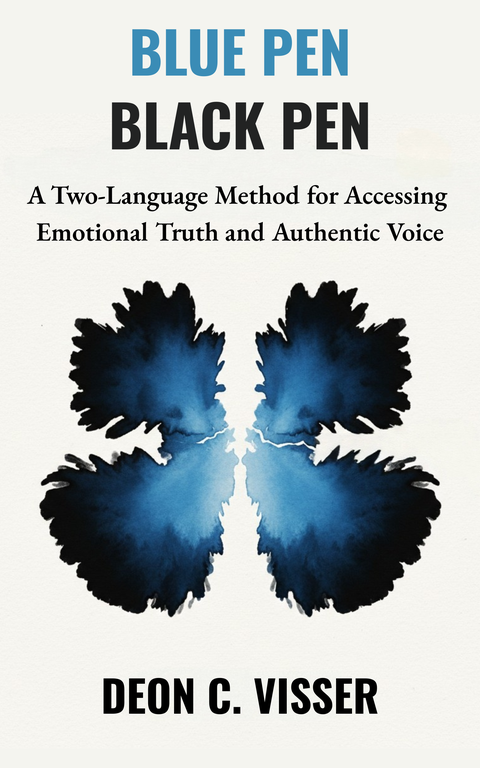
A two-language method for accessing emotional truth and authentic voice — born from a seminar where one hand cramped in "safe" English, and the other reached, unconsciously, for a different pen and a different language entirely.
"I write in blue pen. My hand hurts."
The line that started the whole method
What if the voice you use to write isn't actually yours?
Two writing instruments. One journal, used two ways. This book teaches a method for reaching the parts of yourself that clean, correct sentences can't touch — the one discovered by accident, in a university creative writing seminar, when the language of thought stopped working and the language of feeling took over without being asked.
Companion tools
Voice Quiz
Thinker, feeler, or between. 8 questions.
Name Your Protector
Meet the part that keeps you shut down.
Two-Pen Card
Build your own version of the method.
Prompt Generator
Genre, mood, skill, time. One exercise.
Session Generator
A whole writing workout, timed.
Constraint Generator
One click. Four rules.
Writing Dice
Roll POV, setting, emotion, twist.
Daily Challenge
One exercise. Today only.
I'm Stuck
Ideas, an exercise, a question.
The method
Blue pen
The thinking language. Open the journal from the front, write forward. Where structure and control live — useful, but not always true.
Black pen
The feeling language. Flip the journal over, open from the back, write forward. Raw, unfiltered, and where the real sentences show up.
One journal. Two entrances. The physical act of flipping the journal over becomes the switching ritual — your hands know a mode change is happening before your mind does. Eventually the two sides meet in the middle. That's integration: both voices, living in the same space, moving toward each other.
Who this book is for
You write clean, correct sentences that say nothing true.
You've been told your "real" language isn't the serious one.
You know exactly what you're avoiding on the page.
You want a method, not just encouragement.
From the book
"Corpse writing — writing that has all the parts in the right places but no pulse."
"English made me think. Afrikaans made me feel. And I'd been unconsciously using different coloured pens to keep them separate."
"The words you're most afraid to use are probably the ones you need."
What's inside
01
The Boy Who Wouldn't Cry
The protector, and why he built the walls in the first place.
02
The Two-Pen Discovery
The seminar moment — one pen for thought, one for feeling.
03
Permission to Use Real Words
Forbidden words, forbidden truths, and who gives you permission.
04
The Line That Makes You Feel
The body as your compass, and why the resistance gets worse before it gets better.
05
When Private Writing Goes Public
What to share, and what to keep sacred.
06
The Ritual of Switching
Training your nervous system to know when it's safe to feel.
07
When to Use Which Language
Moving between thinking and feeling on purpose.
08
Your Language Map
A ten-minute daily practice, and where to go from here.
Plus: preface, acknowledgments, further reading & references, and an appendix — "The Stories We Tell Ourselves" (2019).
This one goes deep — it's a craft book, but it doesn't flinch. It works with real emotional and trauma material, and it's upfront that writing is a practice, not a replacement for therapy. The book itself was written alongside a counsellor, not instead of one.
Part of Write Your Way Home
Blue Pen, Black Pen is Book 1 of 2 in the series so far. The first tool, the entry point, the breakthrough that made the rest of the series possible. More mini books are planned, each one laser-focused on a single method.
Corpse Writing
Writing as Drag
Naked Writing
Writing in a Borrowed Tongue
Writing Toward the Dead
Writing, Undone
About the author
Deon C. Visser is a South African writer living in Rayong, Thailand, where he teaches English while developing his creative work. Writing in both English and Afrikaans, his work explores white African identity, queer experience, and the interior life of the writer — what happens before the first word, inside the silence, and after the page is turned. He is also, allegedly, still working on Die Klippenkraal Kronieke, an Afrikaans fantasy series in progress since 2018.